About This Paper
Hourly billing dominates the offshore staffing industry by inertia, not by design. The model was inherited from professional-services consulting, where it makes sense for variable-effort engagements. It does not make sense for ongoing role-based staffing — and the structural problems it creates compound month over month.
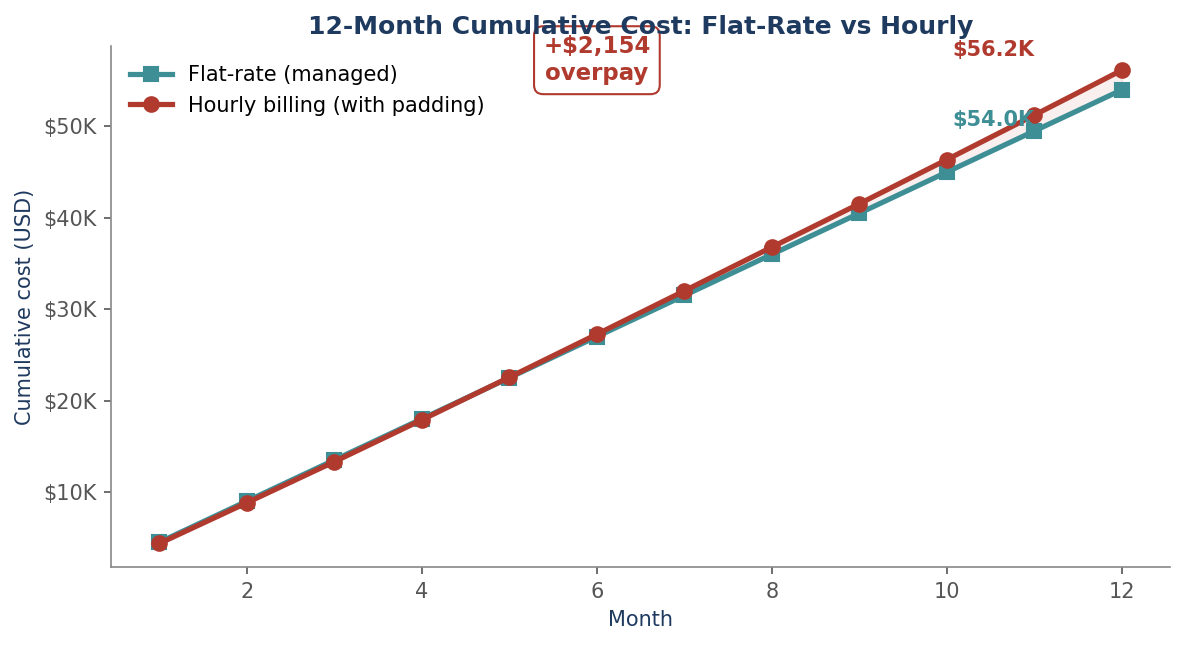
This paper unpacks the pricing economics: how hourly billing creates incentives for time-padding rather than output, why the cumulative cost curve diverges from advertised hourly rates within the first quarter, and the predictable budget overruns that follow. It then shows the math behind flat-rate pricing — why it aligns the staffing partner with the SMB's actual outcomes, eliminates billing-review overhead, and produces ~15–25% lower total cost over a 12-month engagement.
Includes real billing data, comparative cost curves, and a decision framework for when each model is appropriate.
Key Findings
- Hourly billing creates time-padding incentives at every levelWorker, agency middleware, and platform fees all benefit from more hours billed. The structural alignment is wrong for ongoing roles.
- Cumulative cost diverges from advertised rates within 90 daysA $25/hour quoted rate typically lands at a $32–$38 effective rate by month four when you include billing-review overhead, dispute resolution, and time-tracking padding.
- Flat-rate produces 15–25% lower total cost over 12 monthsAfter accounting for the operational overhead of hourly billing — review time, FX volatility, surprise overruns, replacement frequency — flat-rate typically lands materially below.
- Flat-rate aligns the partner with outcomes, not hoursWhen the partner is paid the same regardless of hours billed, the partner's incentive shifts from 'maximize billable time' to 'place a hire who succeeds long-term so the contract renews.'
What's Inside
- The Inheritance ProblemWhy hourly billing dominates offshore staffing despite being a poor fit for ongoing roles.
- The Hidden Math of Hourly BillingHow the advertised rate becomes an effective rate 25–50% higher within the first year.
- Time-Padding IncentivesHow structural incentives at the worker, agency, and platform levels all push toward more billed hours.
- The Cumulative Cost CurveSide-by-side comparison: hourly vs flat-rate over 12, 24, and 36 months.
- When Hourly Makes SenseThe narrow set of cases where hourly is the right choice (project-bound, narrow-scope, time-bounded engagements).
- The Flat-Rate AlignmentWhy flat-rate makes the partner's incentive 'place someone who stays' instead of 'bill more hours.'
- Decision FrameworkHow to choose between hourly and flat-rate for a given role or engagement.
Sources & Citations
- Deloitte. 2024 Global Outsourcing Survey
- Insignia Resources. Outsourcing Rates by Country: 2025 Pricing Benchmarks
- Upwork & Fiverr Annual Reports 2024
- Toptal published rate cards 2024–2025
- Hire Mountain. Internal Billing & Cost Comparison Data 2024–2026
- AGSI. Offshore Staffing Philippines 2026: Real vs Hidden Costs
Read the full white paper
10 pages of evidence-based analysis · April 2026 · Free, no email required
Download PDF →