About This Paper
Most North American SMBs that fail at offshore staffing fail for the same reason: they treat it as a hiring tactic when it's actually an operating-model decision. They post a job, vet a resume, sign a contract, and assume the relationship will function the way a domestic hire functions. It does not.
The companies that succeed treat global team-building as a deliberate seven-stage discipline — role architecture, market selection, sourcing, work-style matching, legal/compliance setup, structured onboarding, and performance management — with each stage having a defined output that feeds the next. This paper compresses what would otherwise be 18 months of trial-and-error into a step-by-step framework.
Built on Deloitte's 2024 Global Outsourcing Survey, Multiplier's 2026 Global Teams Report (5,000+ companies), the WEF Future of Jobs Report 2025, and direct operational data from Hire Mountain placements across India, the Philippines, Vietnam, and Mexico (n=1,847).
Key Findings
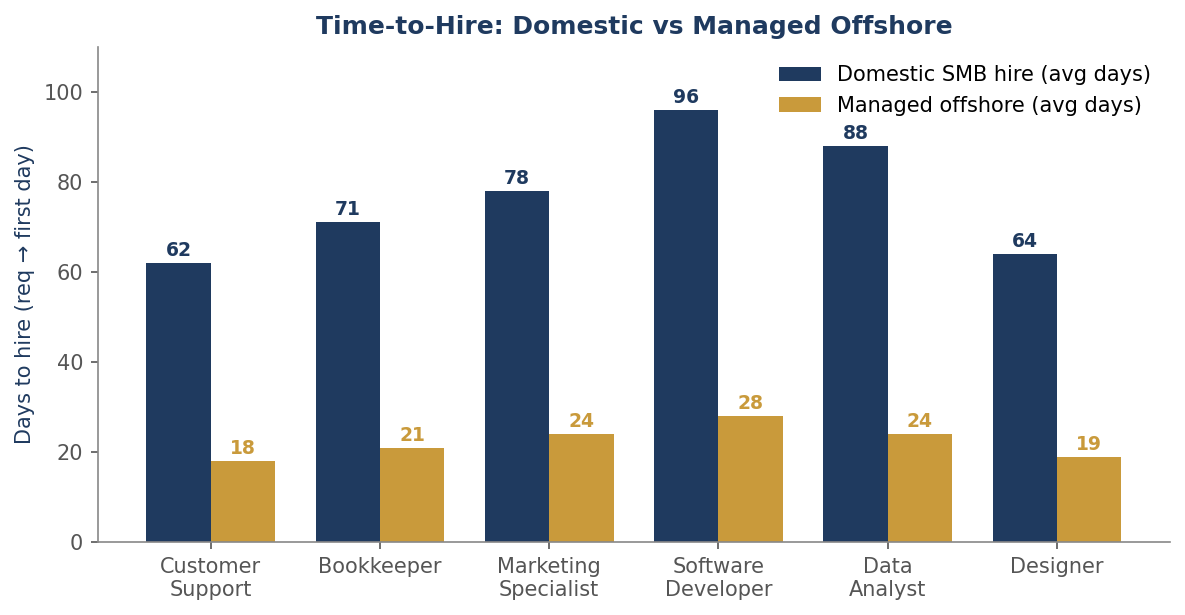
- Time-to-hire collapses from ~75 days domestic to ~22 days offshoreWhen the process is structured. SMBs running ad-hoc hiring on freelance platforms see the opposite: weeks of evaluation followed by 30–45% first-90-day failure rates.
- Work-style matching, not skills matching, determines retentionLeadership IQ's research across 20,000 hires found 89% of new-hire failures are work-personality factors — coachability, motivation, temperament, attitude — not technical. Skills-only screening produces predictable failure rates of 40%+ regardless of source.
- Onboarding is the highest-ROI investment in the processSMBs that invest two structured weeks in onboarding hit role-readiness at week three. SMBs that skip structured onboarding hit role-readiness at week 10–14, if ever.
- The maturity curve is real and predictableFirst hires require ~30% of a domestic manager's time. By the third or fourth hire, that drops to under 10% as systems and culture form. This is the inflection point where offshore goes from a workaround to a structural advantage.
What's Inside
- The Strategic FrameWhy SMBs are building global teams in 2026 — the demographic forcing function and the SMB-specific dynamics.
- Role ArchitectureDesigning roles for offshore success: documentable processes, verifiable outputs, and the four-criteria framework.
- Market SelectionChoosing among India, Philippines, Vietnam, Mexico, and others based on role-fit, cost, and operating model.
- Sourcing & MatchingHow to source quality candidates and apply work-style matching to predict 90-day fit.
- Compliance & Legal StructureContractor vs employer-of-record vs managed staffing — the structural choice that determines risk.
- Structured OnboardingThe five-day model: access, context, process, tooling, and feedback — the sequence that compresses ramp time.
- Performance Management at DistanceHow to inspect output, give feedback, and develop offshore staff in an asynchronous operating cadence.
Sources & Citations
- Deloitte. 2024 Global Outsourcing Survey
- Multiplier. Global Teams Report 2026 (5,000+ companies)
- World Economic Forum. Future of Jobs Report 2025
- Korn Ferry. The Global Talent Crunch (2018–2025 update series)
- Leadership IQ. Why New Hires Fail (n=20,000+)
- ManpowerGroup. 2026 Global Talent Shortage Survey
- Hire Mountain. Internal Placement Data 2024–2026 (n=1,847)
Read the full white paper
11 pages of evidence-based analysis · April 2026 · Free, no email required
Download PDF →