About This Paper
The first offshore hire is the easy part. Managing the offshore hire so they become a long-term contributor — that's where most SMBs lose. The failure modes are predictable, the operating cadence is learnable, and the difference between a team that compounds institutional knowledge over three years and a team that cycles through hires every twelve months is almost entirely a function of management discipline.
This paper is the founder's playbook for the first 100 days of running an offshore team: how to structure the operating cadence, the timezone arithmetic that actually matters, the async-first communication patterns that turn distance into an advantage, and the early warning signs that predict a placement failing before the manager realizes anything is wrong.
Drawing on Buffer's State of Remote Work, GitLab's distributed-work playbook, Multiplier's 2026 Global Teams Report (n=5,000+), and Hire Mountain's operational data from 1,847 placements across five markets.
Key Findings
- Async-first communication doubles offshore productivityTeams operating on async-default communication patterns produce 38% more weekly output per worker than teams forcing synchronous meetings across 12-hour timezone gaps.
- The failure modes are predictable — and surface on a known timelineMost placement failures show signals in weeks 4–6 (the silent-output period); manager-aware teams catch these early. Manager-blind teams discover them in week 12 when work products miss.
- Timezone overlap is over-rated; written-context discipline is under-ratedWhat separates high-performing distributed teams from struggling ones is not how many hours of overlap they share — it's the quality of their written context (specs, definitions of done, decision logs).
- Weekly retrospective cadence is the highest-leverage management practice30 minutes per week per direct report, structured around what worked, what was unclear, and what should change — costs ~2 hours per week per offshore hire and recovers 5–10× the investment in clarity.
What's Inside
- Why the First 100 Days Matter MostThe operating habits established in the first quarter set the trajectory for the relationship's lifetime. Most failures trace to founders who treated weeks 1–4 as administrative.
- Timezone Math (and Why It's Not What You Think)The 11-hour offset is not the problem. The cost of a 12-hour clarification cycle on an unclear ticket is the problem.
- Async-First Communication PatternsWritten specifications, recorded video walkthroughs, decision logs, and the architectural choices that turn distance into a feature.
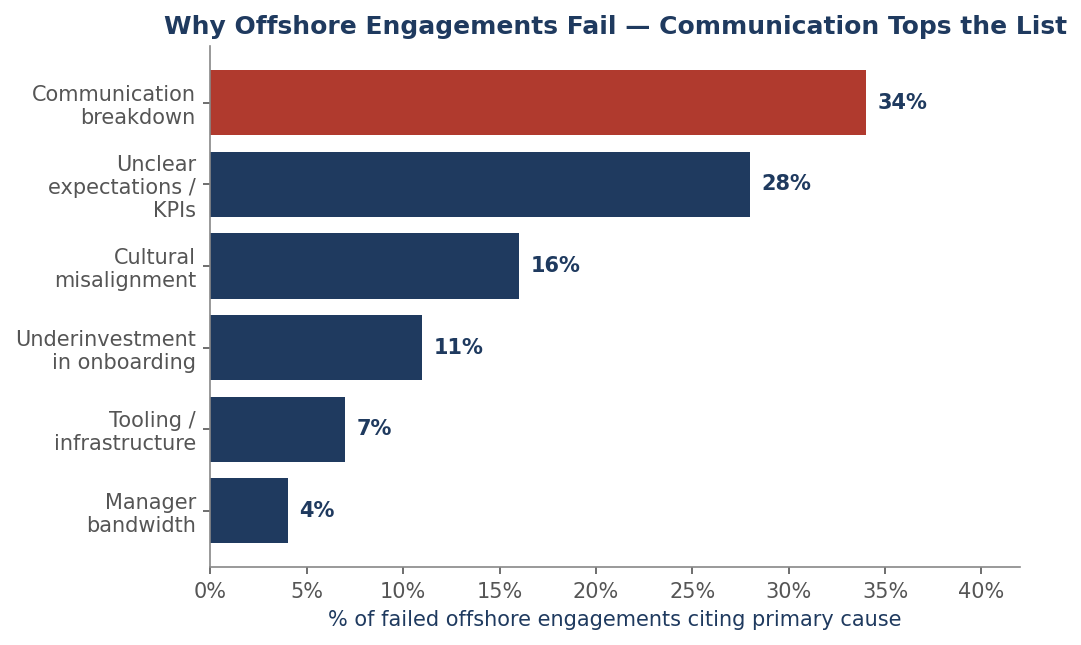
- The Five Most Common Failure ModesSilent-output drift, brief-doesn't-match-output gap, escalation suppression, ambiguity paralysis, and culture-distance shock.
- Operating Cadence: Daily, Weekly, QuarterlyWhat to inspect when, who runs each touchpoint, and the documentation rhythm that scales.
- Early Warning SignsThe signals that predict a placement failing in weeks 4–6 — and what to do when you see them.
- Performance Management at DistanceHow to give feedback, develop offshore staff, and run quarterly reviews when 1:1 hallway conversation isn't an option.
Sources & Citations
- Buffer. State of Remote Work 2024
- GitLab. Distributed Work Handbook (open-source playbook)
- Multiplier. Global Teams Report 2026 (n=5,000+)
- Deloitte. 2024 Global Outsourcing Survey
- Microsoft. Work Trend Index 2024
- Harvard Business Review. Distributed Work and Manager Effectiveness studies (2022–2024)
- Hire Mountain. Internal Placement Data 2024–2026 (n=1,847)
Read the full white paper
11 pages of evidence-based analysis · April 2026 · Free, no email required
Download PDF →