About This Paper
The dominant predictor of new-hire failure is not skill. It is fit. Leadership IQ's longitudinal study of 20,000 new hires across 312 organizations found that 89% of new-hire failures within 18 months were attributable to work-personality factors — coachability, motivation, temperament, communication style — while only 11% were due to technical-skill gaps.
Yet most hiring processes spend 70%+ of their evaluation time on technical skills review. The mismatch is structural and expensive — and in offshore staffing, where work-style mismatches stay invisible for weeks rather than surfacing in days, the cost asymmetry is severe.
WorkStyle Compass™ is Hire Mountain's work-personality matching methodology, purpose-built for the specific operating reality of cross-cultural, asynchronous, distributed work. This paper documents the underlying research, the six dimensions measured, the validation data behind the 60% reduction in placement failures, and the operational implementation in the Hire Mountain workflow.
Key Findings
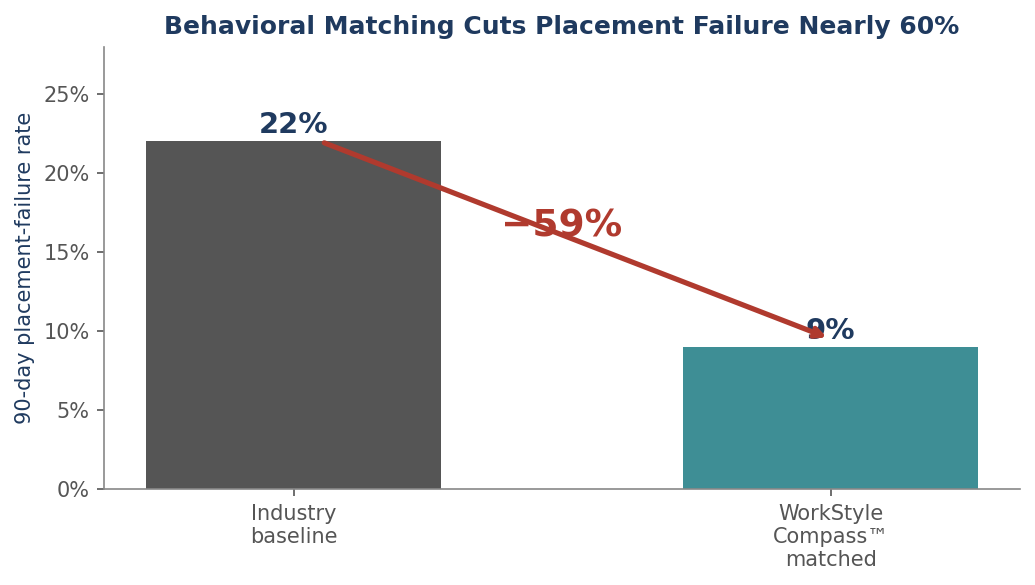
- 90-day placement-failure rate: 9% with WorkStyle Compass™ matching vs. 22% industry baselineA 59% reduction in early failures. Sample: 1,847 placements 2024–2026, stratified by role-mix, client-tenure, and market.
- 12-month retention: 87% with matching vs. 64% baselineA 23-percentage-point improvement in first-year retention.
- Time-to-productivity: 18 days median vs. 38 days baselinePlacements reach role-readiness more than twice as quickly when work-style fit is part of the matching criteria.
- Manager-reported satisfaction at 90 days: 4.5 / 5 vs. 3.1 baselineA 45% lift in qualitative satisfaction scores.
- Replacement requests within 90 days: 6.2% vs. 16.4% baselineA 62% reduction in early replacement requests.
What's Inside
- The Real Cost of a Bad HireWhy the SHRM 213–243% figure for senior-role bad hires understates the true cost in offshore engagements.
- Why Skills-Based Matching FailsThe Leadership IQ finding (89% of failures are work-personality), and why offshore distance amplifies the problem.
- The Science of Work-Style ProfilingBig Five (OCEAN), DISC, and Hogan-derived constructs: which frameworks have predictive validity and which don't.
- The Six Compass DimensionsAutonomy preference, communication cadence, detail orientation, risk posture, feedback orientation, cultural-bridging capacity.
- The 60% Reduction MethodologySample, controls, and selection-bias mitigation behind the published outcome differential.
- Cross-Cultural CalibrationHow the same workplace tendency is interpreted differently across markets — and how the Compass adjusts.
- Implementation in the Hire Mountain WorkflowHow the methodology integrates with sourcing, screening, and quarterly recalibration.
Sources & Citations
- Murphy, M. Hiring for Attitude. Leadership IQ (HBR summary 2019)
- Barrick, M. & Mount, M. The Big Five and Job Performance (Personnel Psychology meta-analysis)
- Salgado, J. The Five Factor Model and Job Performance (Journal of Applied Psychology)
- Schmidt, F. & Hunter, J. The Validity and Utility of Selection Methods
- SHRM. 2024 Cost of a Bad Hire Report (213–243% of salary)
- Meyer, E. The Culture Map: Breaking Through the Invisible Boundaries of Global Business
- Hire Mountain. WorkStyle Compass™ Methodology Validation Study, March 2026
Read the full white paper
11 pages of evidence-based analysis · April 2026 · Free, no email required
Download PDF →